Quick answer
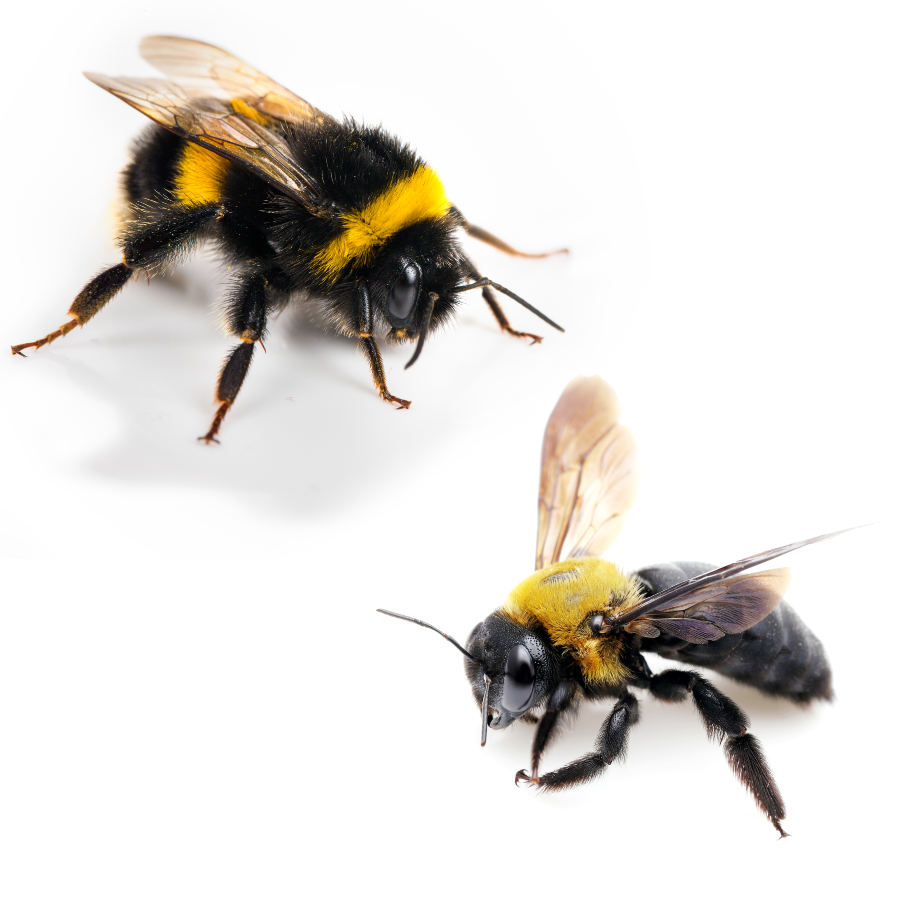
Carpenter bees usually have a glossy, mostly hairless black abdomen and excavate nearly round holes in wood. Bumblebees have a fuzzy abdomen with black and yellow coloration and usually form social colonies in underground or sheltered cavities. Both are important pollinators. Control is most appropriate when nesting causes structural damage or creates a practical safety concern.
Large bees hovering around a deck or eave are often labeled “bumblebees,” but behavior and nest evidence can tell a different story. Carpenter bees commonly inspect exposed wood in spring, while bumblebees forage among flowers and travel to a colony entrance in soil, an abandoned rodent burrow, or another protected cavity.
Correct identification protects the structure without treating pollinators unnecessarily. If large bees are entering wood, Dixie Exterminators can inspect the activity and explain whether stinging-insect or nest service is appropriate.
Carpenter Bee vs. Bumblebee Comparison
| Feature | Large carpenter bee | Bumblebee |
|---|---|---|
| Abdomen | Glossy black and mostly hairless on top | Fuzzy, with black and yellow hairs |
| Nesting style | Mostly solitary; female excavates tunnels in wood | Social colony with a queen and workers |
| Common nest site | Eaves, fascia, porch ceilings, rails, trim, siding, fences, and furniture | Ground cavities, abandoned rodent burrows, compost, wall or foundation voids, and sheltered spaces |
| Visible evidence | Round hole, coarse sawdust, staining beneath opening, repeated hovering | Multiple bees using one concealed entrance; no drilled wood tunnel |
| Stinging | Females can sting but rarely do; males cannot sting | Workers and queens can sting, especially when the colony is disturbed |
| Primary concern | Repeated wood tunneling and secondary woodpecker damage | Nest location near traffic, mowing, doors, or people with sting risk |
How to Identify Carpenter Bees
Large carpenter bees in Georgia are robust bees about three-quarters of an inch or longer. The thorax is hairy, but the upper abdomen looks black, smooth, and shiny. Males often have lighter facial markings and hover directly in front of people or other insects. This territorial display looks aggressive, but males do not possess stingers.
Females can sting but usually do so only when handled or strongly threatened. They spend much of spring selecting wood, excavating tunnels, collecting pollen, and provisioning nest cells.
Signs of a carpenter-bee nest
- a round entry hole roughly the diameter of a finger;
- coarse sawdust beneath the opening;
- buzzing or chewing sounds inside wood;
- yellow-brown staining below the hole;
- bees repeatedly entering the same beam, rail, trim, or eave;
- woodpecker damage around established tunnels.
The female typically bores across the grain briefly, then turns and tunnels with the grain. She divides the gallery into cells with pollen provisions for developing larvae. Existing tunnels may be reused and extended over multiple years, so a few entry holes can hide more internal excavation than the surface suggests.
How to Identify Bumblebees
Bumblebees are also large and robust, but their abdomens are visibly hairy. Color patterns vary by species, so fuzziness is more useful than memorizing one stripe pattern.
Bumblebees are social. A queen starts the colony, and workers forage throughout the season. The nest is often underground in an abandoned rodent burrow, beneath dense vegetation, inside compost or insulation, or in another existing cavity. Bumblebees do not excavate round tunnels in sound wood.
Signs of a bumblebee colony
- several fuzzy bees using the same ground-level or cavity entrance;
- steady foraging traffic rather than one bee guarding a wood hole;
- activity around flowers followed by direct travel to a concealed entrance;
- defensive behavior when mowing, trimming, or walking close to the nest.
Why Carpenter Bees Choose Buildings
Carpenter bees favor bare, weathered, or unfinished wood, especially softer species such as pine, cedar, cypress, and redwood. Common sites include porch ceilings, fascia, rake boards, railings, rafters, window trim, fences, barns, pergolas, and outdoor furniture.
Painted or pressure-treated wood may be less attractive but is not completely bee-proof. End grain, hidden upper surfaces, failed coatings, and old nest holes remain vulnerable. Reused tunnels and woodpecker feeding can turn repeated seasonal activity into a repair problem.
How Much Damage Can Carpenter Bees Cause?
One new tunnel usually causes limited structural damage. Concern grows when many females use the same area over several years, galleries intersect, thin trim is excavated, or woodpeckers tear open the surface to reach larvae. Staining and visible holes can also become a cosmetic problem before structural capacity is affected.
A pest inspection can identify active holes and likely reuse. A carpenter or structural professional should evaluate severely tunneled, load-bearing, split, or decayed wood. Pest service does not determine whether a structural member remains safe.
When Bees Can Be Left Alone
Both carpenter bees and bumblebees pollinate Georgia plants. If carpenter bees are nesting in an isolated fence post or natural wood away from people and important structures, observation may be reasonable. A bumblebee nest in a quiet corner of the landscape may complete its annual cycle without intervention.
Consider professional help when:
- carpenter bees are repeatedly tunneling eaves, decks, trim, or structural members;
- woodpeckers are enlarging the damage;
- a bumblebee entrance is beside a door, walkway, play area, or mowing route;
- bees are entering an occupied wall or ceiling void;
- someone at the property has a history of serious sting reactions;
- the insect may actually be a wasp, hornet, or honey bee and identification is uncertain.
Managing Carpenter Bees
A useful plan combines active-nest management, repair timing, and surface prevention. Treating or plugging one visible hole while other active galleries remain can drive bees to new exits or leave developing young inside.
- Map active and historic holes.
- Determine whether adults and developing young are present.
- Use a labeled, targeted method when control is justified.
- Allow the product and nest cycle to work as directed.
- Repair or replace damaged wood at the appropriate time.
- Finish exposed surfaces and monitor for reuse the next spring.
Traps may capture some carpenter bees but do not repair active galleries or protect all nearby wood. Paint and finish can discourage nesting, yet existing holes and uncoated edges still need attention.
Managing Bumblebee Nests
First confirm that the insects are bumblebees and locate the entrance from a safe distance. Avoid mowing, trimming, digging, or blocking the opening. Colonies are annual and generally decline later in the year, so a low-risk nest may be left in place.
When the nest location creates unavoidable contact or a serious sting risk, professional evaluation can determine whether treatment is justified and where it can be performed safely. Do not pour gasoline, bleach, boiling water, or homemade mixtures into a ground nest.
What Not to Do
- Do not judge the bee only by size; inspect abdomen hair and nest evidence.
- Do not swat hovering male carpenter bees near a ladder or edge.
- Do not plug an active carpenter-bee hole immediately without considering adults and young inside.
- Do not spray flowering plants or broad areas when the problem is one structural nest.
- Do not block a bumblebee entrance while workers are active.
- Do not attempt removal near electrical lines, high roof edges, occupied wall voids, or people with severe allergy risk.
- Do not remove a honey bee colony as though it were a carpenter bee or bumblebee nest.
Georgia Seasonal Timing
Carpenter bees become conspicuous in early spring as overwintered adults emerge, mate, and prepare nests. New adults develop and emerge later in summer, then may overwinter in existing galleries. This cycle makes spring inspection and late-season repair important.
Bumblebee queens establish colonies in spring. Worker numbers grow through summer, and the colony declines later in the year after new queens and males are produced. Seasonal timing should inform whether a nest can be monitored or requires action now.
Frequently Asked Questions
What is the easiest way to tell a carpenter bee from a bumblebee?
Look at the upper abdomen. A large carpenter bee usually has a glossy, mostly hairless black abdomen, while a bumblebee has a visibly hairy abdomen with black and yellow coloration.
Do bumblebees drill holes in wood?
No. Bumblebees usually form social colonies in sheltered cavities, often underground. Round holes with coarse sawdust beneath them are more consistent with carpenter-bee nesting.
Can carpenter bees sting?
Female carpenter bees can sting but usually do so only when handled or strongly threatened. Territorial males often hover near nest sites, but males do not have stingers.
Should every carpenter bee be killed?
No. Carpenter bees are native pollinators. Control is most appropriate when repeated tunneling is damaging building materials or the nest location creates a practical safety problem.
When should carpenter-bee holes be repaired?
Repair timing should account for active adults and developing young so bees are not trapped inside. After the nest is inactive or appropriately treated, damaged wood can be filled, finished, and monitored for reuse.
Confirm the Bee and the Nest Before Taking Action
Dixie Exterminators can inspect bee activity around Marietta and much of Metro Atlanta, identify likely carpenter-bee damage, and explain control and repair steps when the insects are affecting a structure.
Authoritative Resources
These primary and professional sources informed the safety, identification, and prevention guidance on this page: